

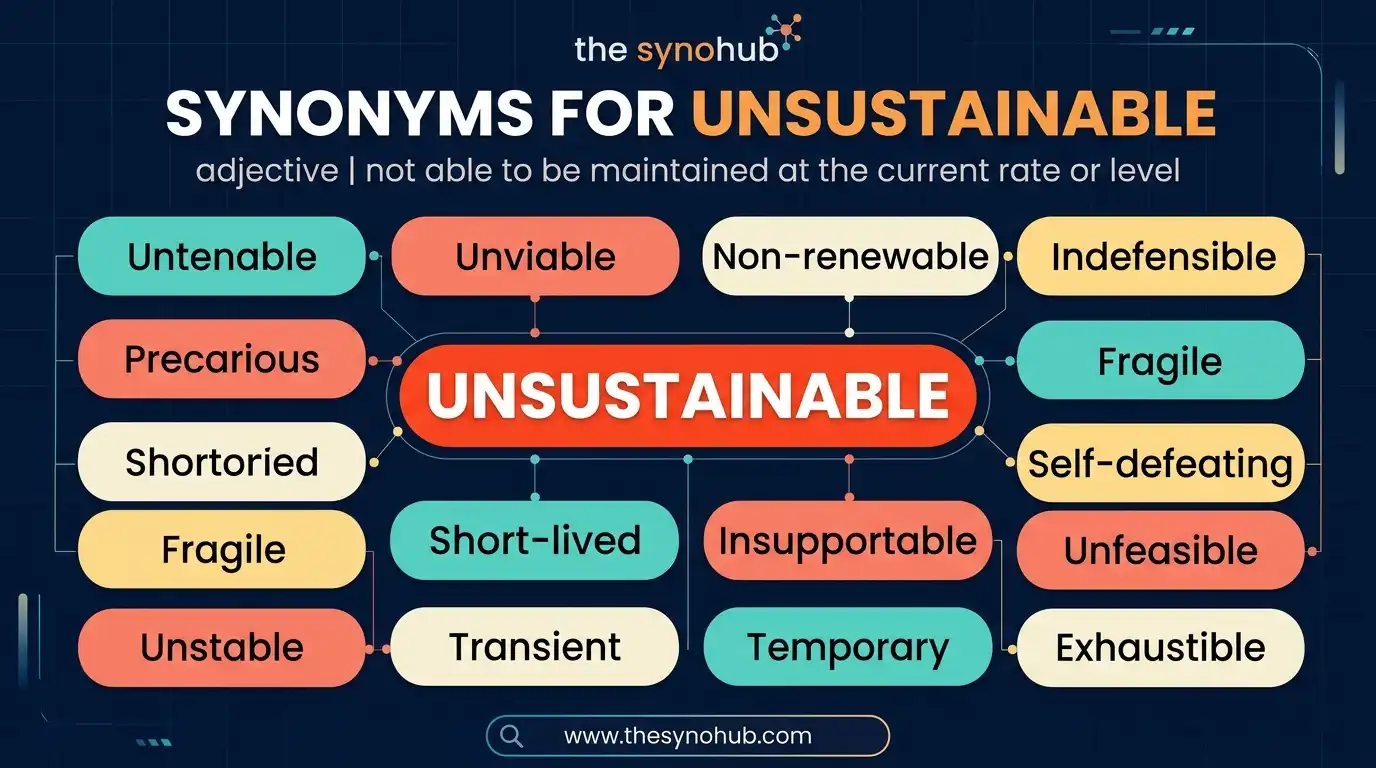
Unable to continue or last over a long time.
Imagine a family spending more money each month than they earn. Soon, they may not have enough money to pay their bills. This kind of plan cannot last for long. It is called unsustainable. The word can also describe harmful ways of using water, land, energy, and other natural resources. Finding the right synonyms for unsustainable can help students, bloggers, and writers explain these problems in clear and simple words.
Quick List of Synonyms for Unsustainable
Here are all the synonyms at a glance. Their meanings and examples follow below.
Untenable, unviable, nonviable, unworkable, infeasible, impracticable, not feasible, not viable, impossible to maintain, cannot be maintained, cannot continue, environmentally harmful, harmful to the environment, ecologically damaging, resource-depleting, depleting natural resources, wasteful, damaging to ecosystems, economically unviable, financially unviable, unaffordable, not cost-effective, loss-making, unmanageable, overwhelming, excessive, too demanding, impossible to keep up, beyond capacity, costly to maintain.

Common Alternatives for Things That Cannot Last
These words describe plans, systems, or ideas that cannot keep working over time. They are useful when talking about business, daily life, work, and long-term plans.
1. Untenable (adjective)
Meaning: A situation or plan that cannot be accepted or continued.
- The team knew that its old plan was untenable.
- His position became untenable after the new facts came out.
2. Unviable (adjective)
Meaning: Not able to work or succeed over time.
- The small shop was unviable without enough customers.
- The project became unviable after its main funder left.
3. Nonviable (adjective)
Meaning: Not able to work, grow, or succeed.
- The farm had a nonviable business plan.
- The team stopped work on the nonviable project.
4. Unworkable (adjective)
Meaning: Not able to work well in real life.
- The school changed its unworkable class plan.
- Their first idea was unworkable because they had too little time.
5. Infeasible (adjective)
Meaning: Not possible to do with the time, money, or tools available.
- The road plan was infeasible because the cost was too high.
- Building the bridge in one week was infeasible.
6. Impracticable (adjective)
Meaning: Too difficult or unsuitable to put into action.
- The plan was impracticable for a small team.
- It was impracticable to carry all the boxes by hand.
7. Not feasible (phrase)
Meaning: Not possible or practical to do.
- The trip was not feasible with our small budget.
- A daily meeting is not feasible for workers in different towns.
8. Not viable (phrase)
Meaning: Not able to work or succeed in the long run.
- The shop was not viable without more buyers.
- The plan was not viable after the price of materials went up.
9. Impossible to maintain (phrase)
Meaning: Too difficult to keep going or keep in good shape.
- The high cost made the new system impossible to maintain.
- Working seven days a week was impossible to maintain.
10. Cannot be maintained (phrase)
Meaning: Not able to continue in the same way.
- This level of spending cannot be maintained.
- The old water system cannot be maintained without repairs.
11. Cannot continue (phrase)
Meaning: Not able to go on for much longer.
- The team agreed that the delay cannot continue.
- This way of working cannot continue for another year.
Alternatives for Environmental Harm
These words and phrases are useful when talking about farming, factories, energy, waste, and natural resources. They describe actions that harm nature or use resources faster than they can be replaced.
12. Environmentally harmful (adjective phrase)
Meaning: Causing damage to nature, air, water, or land.
- Burning waste in the open is environmentally harmful.
- The factory stopped using an environmentally harmful method.
13. Harmful to the environment (phrase)
Meaning: Causing damage to the natural world.
- Plastic waste can be harmful to the environment.
- The company replaced a product that was harmful to the environment.
14. Ecologically damaging (adjective phrase)
Meaning: Causing harm to plants, animals, or natural areas.
- Cutting down the whole forest was ecologically damaging.
- The road plan could be ecologically damaging to the local area.
15. Resource-depleting (adjective)
Meaning: Using up natural resources such as water, soil, or fuel.
- The resource-depleting process used too much fresh water.
- Farmers looked for a better choice than the resource-depleting method.
16. Depleting natural resources (verb phrase)
Meaning: Using natural materials faster than they can be replaced.
- The factory was depleting natural resources at a fast rate.
- Using too much fresh water is depleting natural resources.
17. Wasteful (adjective)
Meaning: Using more materials, energy, or money than needed.
- Leaving the lights on all day is wasteful.
- The farm changed its wasteful use of water.
18. Damaging to ecosystems (phrase)
Meaning: Causing harm to the plants, animals, and places that form a natural area.
- Dumping chemicals into rivers is damaging to ecosystems.
- The new project could be damaging to ecosystems near the lake.
Financial and Business Alternatives
These words describe plans, costs, or business methods that cannot keep going because they use too much money or fail to bring enough income. They are useful in business reports, schoolwork, and money-related writing.
19. Economically unviable (adjective phrase)
Meaning: Not able to work as a good choice because of its cost or low income.
- The factory was economically unviable after sales fell.
- The farm found the new machine economically unviable.
20. Financially unviable (adjective phrase)
Meaning: Not able to continue because the money does not cover the costs.
- The small company became financially unviable.
- The project was financially unviable without extra funds.
21. Unaffordable (adjective)
Meaning: Too costly for a person or group to pay for.
- The high rent made the shop unaffordable.
- The school could not buy the unaffordable new machines.
22. Not cost-effective (phrase)
Meaning: Costing too much for the results it gives.
- The old machine was not cost-effective.
- Buying a new truck was not cost-effective for the small farm.
23. Loss-making (adjective)
Meaning: Losing money instead of earning a profit.
- The loss-making shop closed after six months.
- The company sold its loss-making branch.
Alternatives for Heavy Workloads and Long-Term Pressure
These words are useful when a person, team, or group has more work or pressure than they can handle for a long time. They can describe work plans, busy schedules, and daily tasks.

24. Unmanageable (adjective)
Meaning: Too difficult to control or deal with.
- The large amount of work became unmanageable.
- The teacher split the unmanageable task into smaller parts.
25. Overwhelming (adjective)
Meaning: So large or difficult that it is hard to deal with.
- The number of daily tasks was overwhelming.
- The family found the rising bills overwhelming.
26. Excessive (adjective)
Meaning: More than is needed, fair, or safe.
- The excessive work hours made the staff tired.
- The farm used excessive amounts of water.
27. Too demanding (phrase)
Meaning: Asking for more time, energy, or effort than people can give.
- The daily work plan was too demanding for the staff.
- Caring for the large garden became too demanding.
28. Impossible to keep up (phrase)
Meaning: Too much to continue doing at the same speed or level.
- The daily costs were impossible to keep up with.
- The team found the fast work pace impossible to keep up with.
29. Beyond capacity (phrase)
Meaning: More than a person, group, or system can handle.
- The extra work was beyond the team’s capacity.
- The old water system was beyond its capacity during the dry season.
30. Costly to maintain (phrase)
Meaning: Requiring too much money to keep working or in good condition.
- The old building was costly to maintain.
- The large machine became costly to maintain after many repairs.
FAQs About Synonyms for Unsustainable
What is the best synonym for unsustainable?
Untenable, unviable, and unworkable are useful choices. The best one depends on whether you are describing a plan, a business, or a situation that cannot last.
What is a simple word for unsustainable?
Unworkable is a simple choice when a plan cannot work. Wasteful can fit when something uses too much water, energy, or other resources.
How can I use another word for unsustainable in a sentence?
Choose a word that matches the problem. For example, you can say, “The plan was unworkable” or “The factory used a wasteful process.”
Conclusion
The right synonyms for unsustainable depend on the problem you want to describe. Use words like unworkable for plans, wasteful for poor use of resources, and financially unviable for money problems. These choices can make schoolwork, reports, blogs, and daily messages clearer. Try three or four new words this week and use them in your own sentences.

Isabelle Warren writes clear synonym guides that help readers find the right word for any sentence. She lists similar words with short meanings and simple examples, so it is easy to see which one fits best.